See how Allvue's Nexius Intelligence platform delivers continuous, loan-level visibility across leverage, covenants, and borrower performance so you can detect risk before it surfaces in your portfolio.
Analysis of private credit loans reveals a meaningful structural shift underway: covenant protections are narrowing, and risk is concentrating in parts of the market with fewer built-in monitoring triggers. Teams will need to adjust to maintain visibility.
Covenant prevalence has declined significantly
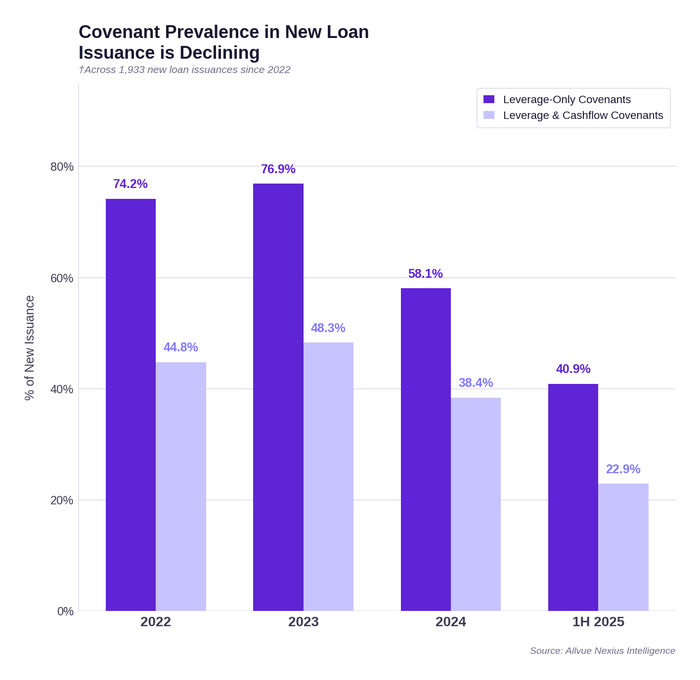
The share of new loans carrying leverage-only covenants dropped from 74.2% in 2022 to just 40.9% by 1H 2025 — a 33 percentage point decline in three years.
The hidden leverage gap
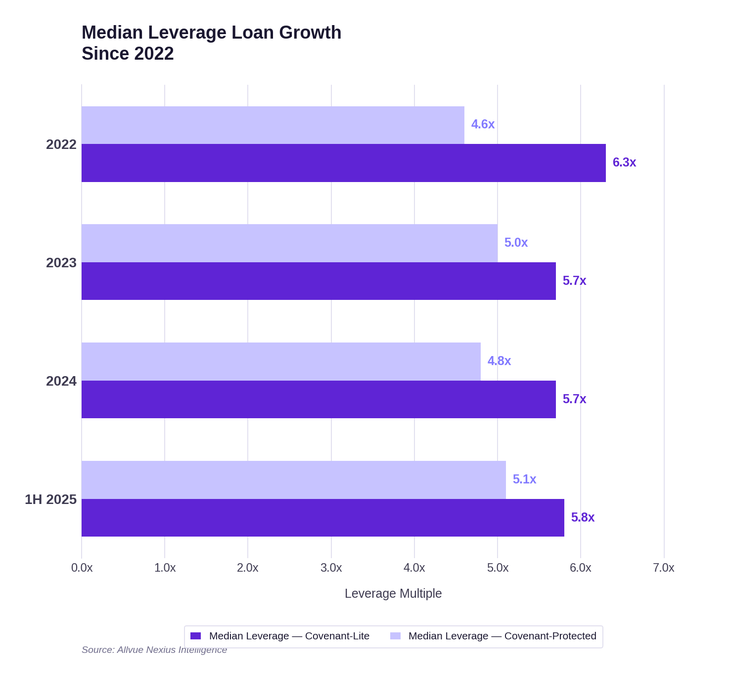
Covenant-lite loans consistently carry 0.7x to 1.7x higher median leverage than covenant-protected deals — a disparity that stable market averages don't surface on their own.
Cashflow coverage covenants are declining fast
Issuances including leverage and cashflow covenants are down nearly 50% since 2022. The covenants historically designed to catch stress earliest are seeing the steepest decline.
Private credit has scaled into a multi-trillion dollar asset class. Regulatory scrutiny, institutional capital flows, and high-profile credit events have intensified focus on underwriting discipline. And when you look at the top line, the market appears remarkably stable: aggregate leverage hasn’t spiked, default rates remain manageable, and capital continues to pour in.
But the surface-level narrative doesn’t capture the full picture. Allvue’s loan-level analysis of 1,933 new issuances since 2022 — drawn from 20 years of proprietary private markets data across the Nexius Intelligence and Nexius Data platforms — tells a more nuanced story. The market isn’t necessarily getting riskier in the traditional sense. But the mechanisms for seeing risk early are changing. And in private credit, visibility has always been central to effective risk management.
The most notable finding in the dataset is the pace of covenant simplification. In 2022, 74.2% of new private credit loans included at least a leverage-only maintenance covenant. By 1H 2025, that figure had fallen to 40.9%.
The shift in cashflow coverage covenants — interest coverage ratios, fixed charge coverage tests — is particularly worth watching. These covenants are specifically designed to detect operational cash-flow stress before leverage ratios deteriorate. They have historically served as private credit’s closest equivalent to real-time early-warning signals. Their share moved from 44.8% in 2022 to 22.9% in 1H 2025 — roughly half the prevalence in three years.
This isn’t a gradual, even trend. The pace of change accelerated between 2023 and 2024, with leverage-only covenants dropping nearly 19 percentage points in a single year. The data suggests the market is moving toward a new structural norm in which lighter covenant packages are increasingly standard.
At an aggregate level, median leverage across private credit has been remarkably stable since 2022 — a datapoint often cited as evidence of market discipline. But disaggregate the data by covenant structure, and a different picture emerges.
Across every vintage in the dataset, covenant-lite loans carry significantly higher median leverage than their covenant-protected counterparts. In 2022, the gap was a full 1.7x — covenant-lite at 6.3x versus covenant-protected at 4.6x. That gap has compressed (to 0.7x by 1H 2025,) — not because cov-lite leverage has dropped, but because leverage on covenanted deals has risen from 4.6x to 5.1x.
The implication is clear: risk is not distributed evenly across the market. It is becoming more concentrated within structurally lighter deals that represent a growing share of total issuance. And because those deals carry fewer built-in monitoring triggers, granular visibility into this segment becomes increasingly important.
Covenant-lite structures are most prevalent in larger, sponsor-backed transactions — the deals that account for a disproportionate share of deployed capital. This means portfolio-weighted risk exposure is likely higher than loan-count-weighted metrics suggest. For NAV lenders and fund finance providers who rely on pooled private credit assets as collateral, this structural concentration compounds the visibility challenge: the largest positions in the borrowing base may carry the fewest early-warning mechanisms.
The combination of these two trends — declining covenants and concentrated leverage — creates a structural shift in how risk is detected in private credit. Historically, maintenance covenants functioned as automated tripwires. When a borrower’s leverage exceeded a threshold or coverage dipped below a floor, the covenant breach forced a conversation between borrower and lender. It created a formal, contractually mandated moment of accountability.
With those tripwires narrowing across a growing share of new issuance, the burden of early detection shifts increasingly to the investor’s own monitoring infrastructure. The question becomes less “will the covenant catch it?” and more “will we see it in time through our own data?”
This dynamic is already playing out. Recent high-profile credit events — many involving fraud, opaque asset-based structures, or off-balance-sheet complexity — have underscored that losses in private credit are often tied to data gaps and limited visibility rather than traditional credit deterioration alone. And notably, many of these defaults have occurred in public or syndicated credit markets. Private credit’s comparative advantage has always been closer borrower relationships and tighter monitoring. As covenant structures converge toward syndicated-market norms, preserving that advantage calls for a deliberate investment in data infrastructure and analytics.
The data doesn't point to an imminent crisis. Rather, it points to a structural change in where and how risk needs to be managed. Here's what that means for the market.
Aggregate leverage stability can mask a bifurcating market. Loan-level and covenant-stratified analysis provides a clearer view of where risk is actually distributed.
Interest coverage and fixed charge covenants historically offered the earliest indication of borrower stress. With their prevalence halved since 2022, the window for detecting risk through contractual triggers has narrowed.
The most competitive, sponsor-backed transactions tend to carry the lightest covenant packages and higher leverage. Capital concentration in these deals means individual credit events can have outsized portfolio impact.
With covenants no longer providing automatic checkpoints across a growing share of issuance, continuous monitoring becomes more important. Traditional spreadsheet-based workflows and quarterly review cycles may not be well suited to a market evolving this quickly.
NAV facilities and fund-level leverage structures increasingly depend on pools of private credit assets. Without granular visibility into covenant structures and leverage dispersion, facility monitoring is incomplete.
Managers and lenders with real-time, loan-level analytics will identify risk and borrower stress earlier, creating a durable edge in underwriting, monitoring, and portfolio management.
Allvue's Nexius Intelligence and Nexius Data platforms provide the loan-level analytics, benchmarking, and monitoring infrastructure that the market's new structural reality demands. Powered by 20 years of proprietary private markets data.
Allvue's Nexius Intelligence platform deliver loan- and deal-level benchmarking across leverage, covenant structures, and performance trends, helping you contextualize underwriting and monitor evolving risk concentrations.
In a market where surface-level metrics mask structural shifts, allocators need granular, independent visibility into the portfolios they're investing in. Allvue provides the data foundation for informed allocation and ongoing oversight.
As NAV and fund finance facilities rely on private credit assets, Allvue's Fund Finance Intelligence extends asset-level benchmarking and monitoring to support oversight, borrowing-base analysis, and ongoing facility management.
See how Allvue's Nexius Intelligence platform delivers continuous, loan-level visibility across leverage, covenants, and borrower performance so you can detect risk before it surfaces in your portfolio.